Showing posts with label Nepal. Show all posts

Thursday, May 14, 2009

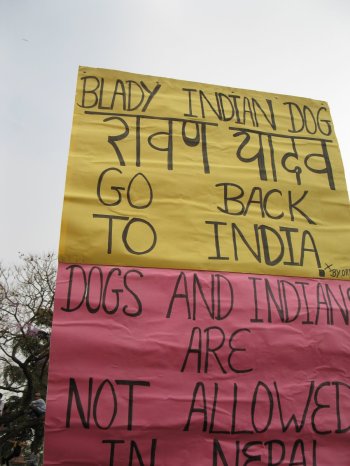
Blady Indian Dogs

Anti India sentiments are running very high in Nepal currently
Nuff said

More pictures from nepal rally

Saturday, March 28, 2009

Ben Peterson in Nepal


Ben Petersen, from Australia, has traveled to Nepal to report directly about the revolutionary events there. He has made a special point of interviewing a wide range of people — to give a real sense of the impact of the Maoist revolution, and also the intense contradictions at this particular moment.

All his articles and views can be found on his blog at
http://maobadiwatch.blogspot.com/

Tuesday, August 21, 2007

INTERVIEW WITH PRACHANDA


What are the planning Maoists have, after their Fifth Plenum? What will be the future of the CA polls? What policy will the Maoists embrace towards India? And how far will the Maoist-SPA alliance go? Maoist Chairman Prachanda spoke on these and various other contemporary issues in an exclusive interview with Nepal magazine recently. Excerpts of the interview.

Q. Your Fifth Plenum (extended meeting) drew much attention. What was so special about it?


Prachanda: The difference between the political circumstances during the earlier four extended meetings and this year’s meeting is the specialty. The earlier extended meetings were held during wartime, for the preparations of the war. This year, the extended meeting took place in a completely new environment of the ongoing peace process and at a time when we, too, are a part of the government.


Secondly, when we entered into the peace process from the process of the People’s War, it was but obvious that several questions would be raised from within and outside the party. The Fifth Plenum has answered all such questions and brought about uniformity in understanding.


Q. What does uniformity in understanding mean?


Prachanda: Transforming a country by addressing the class, caste, regional and gender issues in the transitional phase in a peaceful manner and being a part of the government to hold a Constituent Assembly election are rare experiments in communist movements. Our party has transformed the people’s war into strategic defense, balance, and then strategic retaliation and then ultimately into the peace process, which is a novel experiment in itself. Therefore, this process would obviously have given rise to several questions from within and outside the party. Whether this process will lead us to success or surrender? Such questions had been raised very naturally. We had to answer such questions. And, understanding the fact that the path we have chosen to bring about social and revolutionary changes in a novel way by analyzing all the revolutions and counter-revolutions of the 20th Century is what we call the uniformity in understanding.


Q. We heard that your party rank and file came down heavily on you, that internal differences were spilled over, and that three lines conspicuously surfaced in the fifth plenum. What is the truth?


Prachanda: This is utter nonsense that I was heavily attacked. Had it been so, it would have been impossible to get the 2200 representatives of the plenum united again at the end. Definitely, the honest revolutionists were gravely concerned whether the party would deviate (from its original path). Because of such concerns, several questions were raised. What about security when the central leaders congregate in Kathmandu? Would the follow the path of deviation like the CPN-UML while staying in Kathmandu and enjoying vehicle ride? It’s true that concerns such as these were raised. But it was more than clear that they had a huge confidence in the leadership.


As far as the three different lines are concerned, they exist in all parties: Rightist, extremist and the middle-path. We represent a revolutionary line. I did not write Prachanda Path in the document of the plenum. But no one said Prachanda Path was the main line and should not be left out. This also helps to understand the line and debates of the party’s extended meeting.


Q. Your earlier documents used to attack directly; this time around you have said many things vaguely. Why?


Prachanda: The language we used when we were in Rolpa and the one we have to use while in Kathmandu has to be inevitably different. The language used while in one’s own base area and the language that is used while in the White Area cannot be the same.


Q. Do you still consider Kathmandu a ‘White Area’?


Prachanda: Yes, because Kathmandu still does not belong to the people.


Q. You often mention the phrase ‘a new or a novel experiment’. What is this experiment for-- for a revolution or a compromise?


Prachanda: When we talk about a new or a novel experiment, it is for a revolution. Considering the global and national situation and development in science and technology, we have to find a conclusion to push forward the revolution and for that a new and novel experiment is required.


Q. What will that revolution do?


Prachanda: In Nepal’s context it (revolution) will alter the feudal-production relationship or the feudal-property relationship. It will also change the feudal-political relationship and the feudal-cultural relationship. Secondly, it will free Nepal and the Nepali people from the interventions of the foreign imperialists, reactionaries and expansionists.


Q. That means, at a certain point, violence could again take place in the name of revolution?


Prachanda: In one way or the other, each revolution is violent. No matter how peaceful a movement you call it, it always has violence and counter-violence. Secondly, we have felt if we can move forward on the political base formed after our 10 years of people’s war, people can achieve freedom in a peaceful manner as well, and we can constitute a new society. And we are currently engaged in the same experiment. But whether it will always remain peaceful or turn violent again does not depend on us; it depends on our opponents. It depends on the imperialist and feudalist elements which are not yet completely defeated. There is a possibility that they could use violence against the people once again. In that case, the people will have to retaliate against them. At that point, the revolution could again turn violent.


Q. So, there still remains a final confrontation, no?


Prachanda: It can be understood that way. If the process we have embraced after the 12-point understanding and other agreements is obstructed and if the people are not given an amicable atmosphere to express their mandate in a peaceful way and if violence is again used against the people, then a final battle can take place.


Q. There have been allegations that it’s you who have been committing violence and excesses through the Young Communist League (YCL).


Prachanda: Some media houses that believe in reactionary violence are engaged in this propaganda. This is not the truth. If you go to the bottom of each such incident, then you will realize that these incidents have taken place in retaliation to the ruling mindset of the ruling class.


Q. You are in the government. Then aren’t you, too, among the rulers?


Prachanda: If one looks at the outer structure (of the government), one can say so. But, in essence, we joined the government just for the sake of the Constituent Assembly polls. We are not the whole-sole in-charge of the power. Power and government are not the same thing. And again, when we joined the government, we were told that it would be run on consensus, which is not happening. If it continues this way, the relevance of us staying in the government will be over.


Q. So, when are you quitting the government?


Prachanda: Our ministers are giving an ultimatum today. Then, it will depend on how the government leadership takes the issue and how it is discussed in the eight-party. It will be sorted out in a few days.


Q. People still have doubts about the CA polls; will the election take place on the said date?


Prachanda: It should. But looking at the preparations made by the government leadership and its modus operandi, we have serious doubts about the polls taking place on November 22. Holding the elections without creating certain essential conditions will not fulfill the people’s aspirations. For example, all the agreements reached so far must be implemented in a proper way. Above all, all the groups, including those in Madhes, which are creating troubles, must be controlled.
Since the Gaur carnage, our more than 50 cadres have been killed. But no action has been taken against the guilty. They are walking free. In such a situation, how can one believe that the government can hold the elections in a proper manner? How can we believe? We have already said that India does have a role in one way or the other in creating unrest in Terai, especially the Hindu extremist groups of India are creating troubles in Terai. The government’s failure to control this has given rise to misgivings about the possibility of elections. Besides, feudal royal and other reactionary forces are also trying to thwart the elections. Therefore, we have been saying that an environment for the elections can be created only by declaring the country a republic before the polls.


Q. It is said that you yourself don’t want the elections because your (party’s) popularity has gone down lately.


Prachanda: There is no reason to doubt us as far as the elections are concerned because thousands of our fighters sacrificed their lives for the CA polls. We cannot be against the polls. Yes, we do feel that we might lose; it’s because the feudalists in the country and imperialists- reactionary forces are hatching conspiracies and trying to marginalize us. Despite that, we are not going to deviate from the election front. We have already formed a high-level committee to write an election manifesto. We will soon announce our first list of the candidates in the preliminary level.


Q. There have been allegations that you are complicating the already sorted out issues like a republican set up and proportional electoral system to obstruct the elections.


Prachanda: When it was decided that the CA polls would not take place on June 20, we wrote a note of dissent that the CA polls would not happen unless the country is declared a republic. After we pitched the republican voice high, parliament amended the interim constitution incorporating a provision that it could remove the king with a two-thirds majority. In this circumstance, how can it be said that we are against the polls. This (republican set up) is our old demand.
As far as the proportional electoral system is concerned, this is what we have always believed in. We had compromised thinking that the elections would be held within June and also because the Nepali Congress did not accept the demand for a fully proportional system. But, we were unable to clarify ‘the compromise’ before the people. We admitted in our fifth plenum that this was a mistake and we clearly put forth that the proportional electoral system is our belief. But we have not said that we will shy away from the elections if the country does not adopt the proportional electoral system. In this situation, how are we obstructing the elections?


Q. On the question of a republic?


Prachanda: Our party has decided that a republican set up is a must. We have already announced that we will run campaigns for the republican set up. However, we will not shy away from the elections if that does not happen.


Q. Is your relation with Prime Minister Koirala thawing?


Prachanda: I won’t call it thawing… But the truth is there is a contradiction in the way the political developments are taking place and the way the Nepali Congress is working. Girija Prasad Koirala and other leaders who, during the people’s war, told us what we did – attacking the headquarters or targeting the choppers – was alright, now act in a way as if they want us go back when we are in the peace process and in the government. We doubt that Koirala is going to have a huge regressive and bourgeois change.


Q. What will be the status of the Koirala government if, in case, the elections don’t take place?


Prachanda: There won’t be the Koirala government if elections don’t take place. Not only will Koirala’s government go, the country will face a huge disaster.


Q. What kind of disaster?


Prachanda: The country will be caught in a complex civil war if the CA polls are not held in proper manner.


Q. Civil war?


Prachanda: Yes, a civil war. The series of events have shown that. At that time the scale of international forces’ intervention will be very large. Many people even indicate Nepal’s fate as that of Afghanistan and Iraq. But not Iraq or Afghanistan, Nepal could turn into a Vietnam of the 21st century. This means, there is a possibility that the Nepali people will once again have to revolt against international intervention. What I believe is, if the peace process does not move forward in a proper manner, yet another people’s revolt is a must.


Q. Are you in a position to organize that sort of people’s revolt?


Prachanda: The people of Nepal have to do that. We, on our part, could of course try to lead the revolt.


Q. But, how much possibility is there of deferring the polls to Baisakh (mid-April to mid-May) through an agreement by amending the constitution?


Prachanda: I don’t think so. It does not happen every time. There won’t be any situation where the Nepali people will tolerate the postponement of polls time and again.


Q. That means, if polls don’t happen in November, there is no possibility of polls at all in the near future?


Prachanda: I think it won’t be wrong to draw such a conclusion.


Q. For what the people’s revolt you are talking about?


Prachanda: Firstly, it is for holding of the polls. If that could not happen, it is for transferring all the power to the people.


Q. Power in the people’s hands means power in your hands?


Prachanda: Power in our hands means power in the hands of those who represent the people


Q. When are you launching your people’s revolt?


Prachanda: The process has already begun. Our comrades who are ministers have outlined certain points and given an ultimatum to quit the government if those points are not met. This itself is the beginning of the revolt.


Q. What will be the eight-party equation if the elections do not take place?


Prachanda: I doubt that the coalition will remain intact if the elections do not take place. Either the eight parties will again launch a fresh movement or some of the parties will join hands with the reactionary forces and some will reach out to the people.


Q. What will be the role of the PLA in the revolt?


Prachanda: The PLA cannot be used in course of the people’s movement. But, anything can happen if a situation arises wherein the country heads towards the people’s revolt. The PLA may not remain inside the ‘cantonments’. It will come out.


Q. What will happen to the UN monitoring/ supervision process if the election does not take place on the scheduled date?


Prachanda: The agreement was for nearly one year. If the election does not take place within that period then the UN’s role would come to an end. There will be no need of the UN to stay here.


Q. Let’s change the context. You claim that there is a conspiracy against you in the Terai. Where was that conspiracy hatched?


Prachanda: The problem in Terai is of a serious nature. It is not true that the Hindu extremists alone are behind it as we had been mentioning sometimes. When we sealed an agreement for the Constituent Assembly elections, representatives of the United States went to Madhes to instigate (the people) against us. America has tried to marginalise the Maoists in Madhes. Secondly, the expansionist faction of the Indian ruling class is also conducting planned activities. Thirdly, the feudal-landlord class, which was earlier displaced from Terai, is also involved for revenge. Fourthly, influence of the parliamentary parties was almost non-existent in Terai. They are also taking it as a chance to reduce the Maoist influence there. All these groups have united against the Maoists. And, the dacoits, murderers and criminals, who were chased away by our activists, have also organized themselves. Therefore, the Madhes problem is multidimensional.


Q. Haven’t you talked to the Indian side about the Madhes affairs?


Prachanda: We have been holding discussions. I have been raising the issue with the Indian ambassador—i. e. with the officials working in Delhi. If India had wanted then this kind of mayhem could have been definitely averted. Now they say that such activities are taking place due to the open border. But, there is no ground to easily accept that. It seems to be part of a strategy to sabotage Nepal’s revolutionary movement. Secondly, the general public in Nepal knows that a big ‘design’ of the Indian ruling class to expand its influence in Nepal-- particularly in Madhes-- has been in play. We have been countering this.


Q. What is your India policy now?


Prachanda: We had raised nationalism as the main agenda when we launched the people’s war. In the latter phase, when our responsible friends were getting arrested in India, and the Indian interventions increased, we started our preparations to fight against India. We discussed about a tunnel war with India. I had prepared a document after studying the tunnel warfare of the Vietnam War.


It is an open secret that we wanted to hold talks with the royalists before ‘February 1’. Our policy on nationalism and threats from India remains the same if the issues of the tunnel warfare and the talks with Gyanendra are viewed together. However, the February 1 incident badly turned the situation towards an autocracy. It was a newer development than our expectation and analysis. After the advent of the autocracy, we had to go against it. We had to forge a working alliance with the parliamentary parties for that. On top of that, we had to opt for an alliance with the Nepali Congress. And for that, we had to seek Delhi’s support.


Q. Why? What is the relationship between Delhi and the Nepali Congress?


Prachanda: There is a very deep-rooted relationship between Delhi and the Nepali Congress. Is that a secret? Observing the developments since this party was born shows a special relation. For instance, we wanted to strike the 12-point agreement in Rolpa. But, we went to Delhi after Girijababu said he won’t come to Rolpa, and would rather meet us in Delhi. We had a tough time hoodwinking (the Indian authorities) to bring Girijababu to our place. But no matter how much we tried to trick the Indian government, we don’t feel that it was unaware of our meetings. Girijababu had stayed as a guest of the Indian government. That (12-point understanding) took place with the Indian government’s consent. In this way, India did have a role in the signing of the 12-point understanding. In other words, it won’t be otherwise to say that we, too, had some kind of relationship with India through the Nepali Congress.


Q. Now, what does India want from you and what do you want from India?


Prachanda: A relationship of equality. We want the past agreements and treaties (with India) be reviewed appropriately. Also, we want India to help us positively in this transitional period as a neighbour. On the part of India, may be it now wants us to work as per its interest and wish? However, we didn’t work in that way after joining the government. What we feel is India did play a role to marginalize our party’s influence in Terai; it wasn’t good.


Q. What do you feel about Indian Ambassador Shiv Shankar Mukherjee’s recent remarks about the CA elections?


Prachanda: The kind of language he used was very objectionable. That is against the Nepali people and the independence of the Nepali state. It gives a clear hint that India wants to dictate things (in Nepal). It smacks of the tone and language of former US ambassador Moriarty.


Q. Are Nepal’s nationality and sovereignty under threat due to foreigners?


Prachanda: Earlier, when I said the country is heading towards a catastrophe, I also meant to hint at the danger looming on Nepal’s national integrity. The way foreign meddling has been on the rise, if viewed in all contexts, it may pose a danger to Nepal’s independence if all nationalist forces do not stand united. However, I don’t think that danger has already come. The national feeling of the Nepali people is very strong. The Nepali people are always ready to make any kind of sacrifice for the country’s independence. Nevertheless, there are indications that do hint at huge conspiracies being hatched against Nepal’s national integrity and national independence.

E-mail

Monday, July 30, 2007

Responsibility for casualties in Nepal's civil war

An article from the journal of The Workers party of NewZealand
http://workersparty.org.nz/

Responsibility for casualties in Nepal's civil war


Jared Phillips

The Spark 28 July 2006

This article is concerned with disproving the assertion that the Communist Party of Nepal (Maoist)-led insurgency has, itself, killed 13,000 or more people since 1996. The mainstream media consistently implies that the Maoist Peoples Liberation Army (PLA) is responsible for 13,000 deaths in Nepal. However, such media are unable to state categorically that Maoists are responsible for the majority of the deaths. In fact, the PLA is not responsible for the majority, or even half, of these deaths.

Human Rights Watch (HRW), an international NGO, stresses that "Most - about two-thirds - of those killed were victims of targeted or indiscriminate attacks and summary executions by the Royal Nepal Army (RNA)." Similarly, according to Nepal-based Informal Sector Service Centre (INSEC), referring to the year 2005, "over 1,500 people have been killed this year with roughly two-thirds of those killed by government troops and the rest by rebels."

Most of the deaths caused by the PLA are accounted for in the removal of RNA and Nepal police posts from the rural districts, and in the assassinations of government officials and district commanders. The CPN(M) publishes estimations of military, police, and government casualties in publicly available War Reports. It has made public apologies for civilian deaths it has caused. It has also invited human rights organisations to investigate those incidents.

The RNA, by contrast, has remained silent on the killing of non-combatants, and the mainstream media has reproduced that silence. This silence - what is not said about casualty responsibility and civilian casualty rates - is one indicator that the PLA is not primarily responsible for the civil war deaths in Nepal.

In the year from the January 2005 state of emergency declaration, journalists lost legal protections gained in 1991, and more than a thousand journalists lost their jobs. In that same period 273 journalists were arrested and 147 were physically assaulted. Since 1996 this type of repression has distorted news reports on which casualty estimations are based.

In 2002, the United States Congress approved $US12 million to train RNA officers and supply 5,000 M-16 rifles. Since 2003, it has become difficult to keep track of the precise amounts of Western financial and military support for the RNA, but the army of the state has been consistently provided with the capability for efficient killing.

Lastly, unlike the Nepalese state, killing is not a part of the CPN(M)'s political programme. In January 1995 the CPN(M), then in parliament, announced that if 40 basic reforms were not initiated for peasants, workers, and minorities in 1995, a revolution would be initiated. To bolster its human rights claims against the CPN(M) the mainstream press has invoked the words "Khmer Rouge" (the murderous regime in Cambodia in the late 1970s). Unlike the Khmer Rouge, however, the CPN(M), however, is pro-industrialisation, has improved literacy, and has actively protected intellectuals in Kathmandu. The CPN(M) also has been quick to point out that it was the US state that supported the Khmer Rouge and is still behind the killing and torturing of tens of thousands around the world, including in Iraq.

It is unfeasible to imply that the Nepalese Maoists have killed 13,000 people in the civil war. A proper deconstruction of casualty responsibility shows that the Maoists have inflicted much fewer fatalities than the RNA. The Maoists' honesty about casualties they have inflicted makes them a more credible source than the RNA. Moreover, the implication that the Maoists have carried out the majority of killings is discredited by the fact that Nepalese journalism, from which the mainstream press draws its figures, has been repressed.

The existence of abundant weapon supplies to the RNA also suggests that the RNA has inflicted many casualties. These points of evidence substantiate the claim that the Maoist PLA should not be held responsible for the majority, or even half, of the casualties inflicted in Nepal's civil war.

Sunday, July 1, 2007

Prachanda leaves for Switzerland

In his first visit to Europe, Maoist chairman Prachanda left for Switzerland on Saturday evening.

He said that he will discuss issues such as peace process, Constituent Assembly (CA) and federalism during his stay there.

Prachanda said that the visit will be helpful in developing international relations of the Maoists.

Talking to reporters at the Tribhuwan International Airport (TIA), Prachanda revealed that his party had good relations with Swiss government officials even during the peak of their conflict.

Another senior Maoist leader Dr. Baburam Bhattarai had already left for Norway a few days ago to take part in an international conference on conflict resolution. He is expected to travel to Switzerland also. nepalnews.com sd Jun 30 07

Nepalnews


India sends anti-china scholar to Nepal

Nepal’s Prime Minister Girija Prasad Koirala today had to spare his half-an-hour time with the visiting self proclaimed Nepal expert Dr. S.D.Muni from India. Mr. Muni is a professor at the JNU (Jawahar Lal Nehru University), New Delhi.

Koirala is learnt to have briefed Mr. Muni on Nepal’s latest political developments as if the latter were the authoritative emissary of India’s living deity-Goddess Sonia Gandhi.

To recall, just a day before Nepal’s PM received the Indian Ambassador Shiv Shankar Mukherjee at his residence.

Mr. Muni is considered to be the mentor of Nepalese leaders, more so those of the Maoists.

He is a close Chum of Dr. Babu Ram Bhattarai- the Maoists deputy in command.

Mr. Muni is considered to have patched up the Maoists’ inner wrangling when Prachanda- the Maoists supreme commander had alleged Dr. Bhattarai as being a pro-India man in the Maoist camp and had even expelled Dr. Bhattarai from the party for quite some time.

Dr. Bhattarai instead alleged Prachanda as being a pro-palace man.

With Muni’s active maneuvering, Prachanda not only reinstated Bhattarai to his initial position but later hailed India for their support on peaceful settlement in Nepal.

The Maoists wrangling took place just few months before the SPA and the Maoists made a Delhi sponsored Agreement (November 22, 2005) to wage a struggle against the fifteen months old King’s regime.

Mr. Muni is supposed to be an undeclared advisor of the South Block establishment and is concurrently presumed to be close to the RAW (Indian Intelligence)- who has been told to keep “eyes” especially on Nepal.

High placed sources have told the telegraphnepal.com that Muni has been especially sent by the South Block mandarins here to monitor the Chinese influence.

Dr. Muni has come close on the heels of Chinese Ambassador’s declaration that his country would very much wish to have formal ties with the Maoists as China has with Nepal’s other major political forces. This Chinese bombshell appears to have jolted South-Block to the extent that it had to send a sharp critic of China. India perhaps thinks that the Maoists might go out of its grip only to be taken care of by China.

For the record, Prachanda’s son Prakash Dahal is currently said to be in China. Father Dahal is talked to shortly visit China.

June 29, 2007

Telegraph nepal


Sunday, June 24, 2007

Video of Interview with Maoist leader Prachanda

Video of Interview with Maoist leader Prachanda
Part 1

Part 2

Part 3


TRANSCRIPT OF THE INTERVIEW

As Nepal goes through a difficult transition, what is the stand of the country’s Maoists on the important issues that will determine the Future? Nepal’s Maoist leader Prachanda spoke exclusively to CNN-IBN on those issues in an interview on Devil’s Advocate.

Karan Thapar: Now that the interim Government has given itself the power to abolish the monarchy, if the King interferes in politics, don't you think you should withdraw your demand for the immediate abolition of the monarchy?

Prachanda: No, we don't feel that. Although the Parliament has already decided that two-thirds majority of Parliament can abolish the monarchy, in that sense we feel that our demand is justified.

Karan Thapar: So you want Parliament to abolish the monarchy immediately?

Prachanda: Yes, we want that Parliament should take initiative and monarchy should be abolished immediately.

Karan Thapar: But then what is the point of having a constituent Assembly in four or five months’ time. This should be decided by the Assembly.

Prachanda: The constituent Assembly is quite necessary to restructure the whole state. It is not the question related only to the monarchy.

Karan Thapar: But the monarchy is an important part of the structure of Nepal. Surely, this is a decision the Assembly should decide. If you don’t decide this in the Assembly, you are disrespecting the Assembly.

Prachanda: We are not disrespecting the Assembly. We have compromised with other parties that after the election, at the first meeting of the Assembly, we will decide the fate of the monarchy. But during this one-year period, it has been proved that until and unless the monarchy is there, it will create disturbance and try their best to derail the process. Therefore, we try to take initiative.

Karan Thapar: So the problem is that you don’t trust King Gyanendra ?

Prachanda: Exactly. But it is not the question of individuals. It’s the question of this feudal institution that should be abolished.

Karan Thapar: So you are not ready to let the Assembly take this important decision?

Prachanda: Why has the Parliament decided right now that two-thirds majority can abolish the monarchy before the elections?

Karan Thapar: But just because the Assembly has given itself the power does not mean it has to exercise the power?

Prachanda: But the provision is there that if serious disturbance comes from the monarchy, in our assessment, serious disturbance has already occurred through the monarchy.

Karan Thapar: All right. Let me question you on that. On Tuesday, your colleague, Baburam Bhattarai said that he is scared that the King might engineer a coup with the help of the Nepalese Army. He even said that General Katwal, the Army Chief is a foster brother of the King. Is that a real fear or is that Mr Bhattarai’s imagination?

Prachanda: It is an open secret that Mr Katwal has been educated and raised by the Monarch therefore he has the real relation with the Monarch. But right now we feel that they are trying to activate their forces. So that is the danger from that kind of a relation.

Karan Thapar: So you are really scared that the King and Mr Katwal could organize a coup?

Prachanda: No, right now, I don’t think they will organize a coup. In some section of leadership of the Army, we heard that they are trying to do some things.

Karan Thapar: But you are not taking that seriously.

Prachanda: No I don’t think as a whole Army, they will take such an initiative. In the whole history of our political development, the Army has not taken such kind of decision. They also know the overall political consciousness of our masses and people.

Karan Thapar: So you trust the Army and are prepared to trust General Katwal?

Prachanda: It is not a question of trust. Katwal may have some sentiments with the Monarch and you will imagine some kind of disturbance. But on the whole I don’t feel that they will be able to take such an initiative.

Karan Thapar: This is very interesting because on this issue you have a slightly different opinion to your deputy. Mr Bhattarai is rather scared about this. You are not worried.

Prachanda: We have information that in some sections they will try but the will not be able to, that is my point.

Karan Thapar: Though the Prime Minister has not said this officially and formally, many people believe that he would like to retain the monarchy in a ceremonial form, perhaps like the British Queen. Do you believe that is Mr Koirala’s actual position?

Prachanda: Yes, I think five years back I had a regular contact discussion with Mr Koirala and he’s not quite clear about his own position. He vacillates questions of the monarchy and the republic.

Karan Thapar: Is he confused or is he trying to find a clever way of keeping the monarchy?

Prachanda: Previously I thought he was trying to find an artful way of abolishing the monarchy. But in the latter half of the development I think he was trying to find an artful way to save the monarchy.

Karan Thapar: So the Prime Minister is trying to save the monarchy?

Prachanda: Yes, when he says ceremonial monarchy and then he says I want to give some political space to the Monarch, all these things prove that.

Karan Thapar: On Sunday the PM revealed that he had advised King Gyanendra and Crown Prince Paras to abdicate in favour of Prince Hridendra. If that were to happen, could the Communist accept a ceremonial monarchy?

Prachanda: It is not a question of Communist. The whole nation will not accept such a ridiculous thing.

Karan Thapar: Not even Prince Hridendra, who is only four or five years old?

Prachanda: Yes, nobody will agree to that.

Karan Thapar: If the constituent Assembly meets and decides to retain the ceremonial monarchy, will the Maoists respect and honour that decision?

Prachanda: We do not believe that kind of a result will come.

Karan Thapar: But if it comes?

Prachanda: If it comes, we will respect what the masses want and we will teach the masses what they did is not correct but we will respect the decision.

Karan Thapar: So you will accept a ceremonial monarchy if the constituent Assembly decides to keep one?

Prachanda: My point is that we will respect the decision and ideologically we will again peacefully try to educate the masses.

Karan Thapar: Peacefully? There will be no arms struggle?

Prachanda: Time and again I have cleared this point that we will respect the decision.

Karan Thapar: The reason I want to clear it again is because at the moment you are demanding immediate abolition. So you will accept a ceremonial monarchy if the constituent Assembly decides to keep one?

Prachanda: Yes. That’s why I’m here. If we do not respect the decision, how can we be part of the elections?

Karan Thapar: That’s interesting because at the same time you want to abolish the monarchy before the Assembly meets but leave that aside. Let us now move on the question on the election of the constituent Assembly. On the 15th of this month, speaking in Kirtipur, you said you don’t even believe it’s likely to happen in December. Given that the election has already been postponed once, are you confident it will be held this year?

Prachanda: We have serious doubt it will be held. We are for the election. As soon as possible, it should be held but because of the experience we have serious suspicion.

Karan Thapar: You are seriously doubting that the election will be held this year?

Prachanda: Yes, we have serious doubt.

Karan Thapar: How much of a responsibility will the that of the Prime Minister?

Prachanda: Main responsibility should be taken by the Prime Minister because when we entered in the negotiation and the agreement, the PM time and again said if I will not be able to hold elections in June, then morally I will not be the PM.

Karan Thapar: Do you think, because he has not been able to hold the elections by June, morally he should step down?

Prachanda: I am not saying that. It’s the PM himself who said this time and again.

Karan Thapar: But you are saying that the responsibility for delay, the failure to hold the election on time is that of the Prime Minister.

Prachanda: Main responsibility is that of the Prime Minister.

Karan Thapar: Why did he fail? Because he does not wants to hold it or is it because he is weak? What is the explanation?

Prachanda: My point is that the Prime Minister and his party could not take the concrete position of the monarchy ad the republic. This vacillation in its political position is the main reason.

Karan Thapar: In your eyes, is the PM vacillating because he is actually trying to find a way of retaining the monarchy and therefore he keeps delaying the elections.

Prachanda: I have serious doubts that the PM wants to retain monarchy and therefore he is trying to play with the situation.

Karan Thapar: How much tension has this introduced in your relationship with the Prime Minister?

Prachanda: There have been many ups and downs, twists and turns in the relationship but yet I think that the relation is not so cold. We are in a warm relation which some times gets very tough as well.

Karan Thapar: Sher Bahadur Doeba, the leader of the Nepali Congress Democratic Party says that the obstacle to holding election with the constituent assembly are the terrorist acts of the Maoists. He blames you.

Prachanda: It is quite wrong. It is Sher Bahadur Doeba himself who doesn’t wants to have elections. For the first time when we entered into this negotiation with Doeba, he is the person who was quite against this election of the Constituent Assembly.

Karan Thapar: Let me put this to you. Suppose the elections do not happen in November-December. How serious will that be for Nepal?

Prachanda: It will be a disaster, I think. Whole political scenario can change in a serious anarchy in this country. I don’t want to imagine the results.

Karan Thapar: If such a disaster happens, can the interim government survive that disaster?

Prachanda: I don’t think so. In that situation, another serious mass movement should be organised and we will be with the masses.

Karan Thapar: When you say that another mass movement should be organised, are you talking about a return to arms struggle?

Prachanda: Not at all. It will be a peaceful mass movement.

Karan Thapar: If you are going to organize a peaceful mass movement, does that mean also that you will leave the interim government?

Prachanda: When we will be forced to go into a serious mass movement, at that time we will abandon the interim government. We will be out of the government, but will be in the legislature.

Karan Thapar: So you will be in the Parliament but leave the interim government?

Prachanda: Yes. That’s right.

Karan Thapar: So let me repeat, what you are saying, that if there are no elections in the constituent assembly in November or December, it will (a) be a disaster in Nepal, (b) you will launch a mass movement and (c) and at that point you will leave the interim government.

Prachanda: Yes. Exactly. We will leave the interim government but will retain in the Parliament and we will handle the mass movement in a peaceful way.

Karan Thapar: Mr Prachanda lets talk about your party of the Maoists. You have agreed to surrender your arms, to out your combatants in camps, to return or cease property and discipline the young communist league. Your critics say that on all these issues, you are cheating. Tell me, are your cadres not refusing to obey your orders or are you only too happy for your orders not to be obeyed.

Prachanda: I want to make it clear that we have not surrendered our arms. We have agreed to integrate both the armies on a new basis.

Karan Thapar: Let me explore that. E N Martin the United Nations Special Representative says that 30,850 Maoist combatants have registered in camps, but only 2,855 arms have been handed it. That is a huge discrepancy. Are you holding back your arms?

Prachanda: The data is incorrect. I think it is somewhere close to 3000.

Karan Thapar: But look at the difference, thirty thousand combatants and just three thousand weapons. Where are the other weapons?

Prachanda: Yes, it is a serious question and time and again I’ve tried to make it clear that our comrades are not all armed with modern weapons. They have been armed with grenade, crude bombs and the likes.

Karan Thapar: Have you surrendered everything? Or are you hiding some stock?

Prachanda: Yes, we have stored all the bombs, grenades, guns and everything. We have in fact registered all the arms and explosives.

Karan Thapar: Let me quote to you what Nankishore Punj the leader of your Maoist army said. He said, “If we detect more arms in the future that are presently out of our memory and control, then we will inform the UN monitors.” How can you not remember where your arms are? It sounds as if you are cheating.

Prachanda: Its not a question of cheating. When we were in the war, we remained in the rural areas, jungles and scattered in different parts of the country. We did not have a really disciplined barrack like that.

Karan Thapar: So you cant remember where your arms are?

Prachanda: The arms may have gone missing in few places.

Karan Thapar: Alright. Let me put in something else to you. E N Martin says that instead of surrendering and registering in camps, your combatants have instead joined the young communist league. In that place, even boys under 18 have been registered.

Prachanda: You have to understand the whole phenomena of communist league. You should go back to the question on the paramilitary forces we have organised during the conflict.

Karan Thapar: Have you moved your Maoist Army combatants into the League?

Prachanda: No that’s not true. However in the league, some combatants are there who were the commanders in PLA. But we have not kept this any secret.

Karan Thapar: These combatants who have joined the young communist league—are they indulging in violence? Because the Prime Minister has gone on record to say that the Young Communist League is like a ‘young criminal league.’

Prachanda: I am sure he must have been out of his mind when he said such a thing. It is a serious charge that they have made. Later on when we discussed it with the PM he said he was sorry for the comment.

Karan Thapar: Did he apologise to you? Did he actually used the word ‘sorry’?

Prachanda: Not exactly. But by his explanation he sounded apologetic. He said it was due to an emotional outburst and the given situations that he said such a thing.

Karan Thapar: Its not just the PM who accuses the Young Communist League of indulging in violence, extortion and intimidation. Sher Bahadur Doeba also says similar things. Many of the members of the Seven Party Alliance too feel the same. Are you using the Young Communist League to intimidate or to threaten?

Prachanda: In my opinion people are exaggerating the whole issue.

Karan Thapar: By saying they are exaggerating, you are hinting that there may be little truth, but they are exaggerating it.

Prachanda: There may have been small incidents, but we are trying to minimize any kind of violence.

Karan Thapar: So do you accept there have been such instances?

Prachanda: Yes.

Karan Thapar: You also told Former President Jimmy Carter that you would correct the ‘mistakes’ of the Young Communist League. So that means you clearly accept those mistakes?

Prachanda: When we were there at the Central Community meeting, I myself said that we will have to minimise such kinds of incidents. But mainly and basically what communist league is doing is correct because they are building roads, plating trees and doing much public work.

Karan Thapar: People say, Prachanda if orders about returning seized land, Maoist leaders disregard him. Do your local cadres disregard your orders?

Prachanda: No it is not the case. Returning the land is a very sensitive question. We have initiated from the Western districts of Nepal. But we still have to settle the question of settlement of peasants.

Karan Thapar: Can people trust Prachanda to do what he says.

Prachanda: They trust and they should trust. We have initiated the process and this is again a very sensitive issue that we have to decide the settlement of peasants.

Karan Thapar: So what you are saying is: Give me time, I will surrender seized property.

Prachanda: It needs some time.

Karan Thapar: But you will fulfill the commitment to surrender seized property? Is that a promise?

Prachanda: Yes that’s a promise.

Karan Thapar: And you will also ensure that the Young Communist League do not indulge in violence, that’s another promise.

Prachanda: Yes that’s a promise. But you should also see that many a times provocation leads to such things. Like it happened in the Tarai region of the Madhesis, when our comrades were provoked into violence.

Karan Thapar: But will you exercise control, now? Will you keep telling them not to indulge in violence?

Prachanda: Yes, very much.

Karan Thapar: My last question is, when the elections to the constituent assembly take place, if you don’t get a majority, will you accept a minority role or will you boycott the Assembly.

Prachanda: We will respect the decision. We may be in the minority and we will struggle ideologically and politically.

Karan Thapar: But will you accept the minority position if that is the outcome.

Prachanda: We must have to accept it.

Karan Thapar: Thank you Mr Prachanda for this candid interview.


CNN-IBN

Counter revolutionary movement gains momentum in Nepal -Is the Indian State and CIA providing training and funding ?

Hindutva Terrorists planning attacks on Maoist Leaders

Kathmandu, June 21 (IANS) A band of former soldiers, ex-police personnel and victims of Maoist guerrillas have united in Nepal to form a Hindu army with suicide bombers to fight Islamic and Christian zealots as well as communists.

Called the Nepal Defence Army, the group is headed by a former policeman who says he joined the Communist Party of Nepal-Unified Marxist Leninist as a schoolboy but has now begun waging war on his former comrades.

The ex-cop, who today calls himself 'Parivartan' (change), claims his band has nearly 1,200 trained soldiers who possess arms and have the expertise to manufacture explosives.

Earlier this year, the Nepal Defence Army made its debut with a couple of blasts, including at the well-guarded office of the Maoists in Kathmandu.

On Wednesday, a Nepali tabloid carried an extensive interview with the shadowy leader, saying he had walked into the tabloid's city office to talk about his organisation.

"Nepal Defence Army has been founded to fight for Hinduism," Parivartan told Nepali weekly Ghanata R. Bichar. "Hindus worldwide support us, including the families of top Maoist leaders. Our soldiers are being trained across the border in India and we get the ingredients for manufacturing explosives from India."

However, the new revolutionary said his group had no links with King Gyanendra.

"We are not funded by the palace," he said. "If the palace had tried to promote Hinduism and Nepal as a Hindu state, we wouldn't have to wage our war. We don't dabble in politics. Our sole aim is to form a Hindu state."

Parivartan told the weekly that his party didn't want bloodshed.

"The bombs we threw at the Maoist office were intended as a warning and not to kill," he said. "I stopped plans to assassinate Maoist chief Prachanda and Maoist minister Dev Gurung.

"But if the warning is not taken seriously, the eight-party ruling alliance can suffer serious losses."

The shadowy leader held Maoists as their main enemy.

"During their 10-year war, the Maoists destroyed and desecrated temples and attacked priests," he said. "But they never destroyed any church or mosque."

However, he added that Maoists' families still remained devout Hindus.

"During the civil war, Prachanda's mother would wake up early in the morning and offer water to the sun god to pray for her son's safety," he said. "It shows they are Hindus and would support Hinduism."

Parivartan ended with a dire warning.

"The Maoists had also begun in a small way," he said. "We learnt how to make bombs from Prachanda's teachings.

"Now, like the Al Qaeda, we are training suicide squads.

"We have trained five suicide bombers who can go anywhere, including Singh Durbar (the heart of administration in Nepal, where the prime minister's office, key ministries and parliament are located.)"

IANS

Monday, June 18, 2007

How was Krishna Sen killed ?

Bhumkal has a post on how
Maoist revolutionary Krishna sen was killed in Nepal in May 2002

After five days of isolation and torture Krishna Sen died, the blows, boots, and lathis of the men in uniform raining down upon him. He was kept captive in the highest building in Mahendra Police Club, next to its Judo Hall. His hands were bound behind his back, and he was repeatedly asked to say “This country belongs to the king.”

Sen had been caught in Naya Baneswor on 20 May 2002 and been in captivity in the Police Club since. Journalist Sangeeta Khadka, who saw Sen at 2 AM on 21 May, said, “After some hours of torture, Sen was vomiting, his arms and legs were broken.” Khadka says two policemen were propping Sen up against a wall as a jackbooted DSP Bikram Thapa kicked him repeatedly.
Bharat Sigdel, then a correspondent for Janadisha was also at the police club at that time.

He says policemen taunted Sen, and assistant inspector general Amarsingh told him, “This country loves only Gyanendra. Do you really want to go against the thakuris who built this country… The army is going to be deployed.

The American Army will also be here. And you’ll be six feet under, that’s where you’ll be. I’m a loyal solider of the king. I’ll bury Prachanda and Baburam too, and pack off Sher Bahadur and Girija to jail.”

Sources say that on 27 May, Sen’s body was bundled into a sack and tossed into a Hilux that had its government number plates roughly coloured over red. The same night, Sen was secretly cremated at Aryaghat. DIG Shah said to his collaborators: “we were just joking, but Sen was already dead.”

Yet, the government put out the news that Sen had been killed in an encounter in the Gokarna forest. The announcement didn’t even include his name, just a description. The government under which Sen was killed made no comment. There has never been an investigation. The people involved in his murder are high-ranking police officers.

Shah denies being involved. “Such work was the domain of the unified command (the army). It was not our concern.” He even denied knowledge of the fact that Krishna Sen had been caught. “Capturing, transporting, taking action was the lookout of the army. How would we know anything about it?” He then deflected the question to the headquarters. “And where is the accounting for all the policemen killed,” he added. “No one is investigating incidents like Nepalganj or Naumule.”

Asked again how the head of the Valley police could not have known, Shah replied: “That’s how things were then. Anyway, this is an old story, and I don’t need to know anything about it.”

DSP Bikram Thapa was sent abroad right after Sen’s murder and won a peacekeeping award. He also denies knowing anything about Sen’s death. In fact, Thapa says, “I’ve never heard of Krishna Sen or of Janadesh weekly.” Thapa who is at the Number 1 Battalion in Naxal is trying for a promotion. Sen was apparently taken into custody by Sub Inspector Vijaya Pratap Shah, who was immediately promoted to inspector. Shah returned from peacekeeping duties in Kosovo six months ago.

A collage of pictures of Maoist Leaders
Click on Image for larger view


Saturday, June 16, 2007

Former U.S. president calls for U.S. to drop terrorist tag on Maoists

Visiting former U.S. president and co-founder of the Carter Center (CC), Jimmy Carter on Saturday said that the United States must establish lines of communication with the Communist Party of Nepal (Maoist) regarding the removal of the terrorist tag imposed on them by the U.S..

Speaking at a press conference prior to his departure to the U. S. after completing his four-day visit to Nepal, Carter said that the present security situation in the country was "unacceptable" but lauded the strides made towards holding the Constituent Assembly elections.

Jimmy Carter

"The Maoists have complied with the United Nations requirements and disarmed to some degree. They have adopted the principle of multiparty democracy. The U.S. should establish communication with the Maoists," Carter said.

"A safe and secure environment is a core requirement for progress in the transition process," Carter said, adding that it is up to the people to decide on monarchy's future since Nepal is a sovereign nation.

"The country has set itself the established goals of holding the Constituent Assembly polls and I support the significant progress towards that objective," Carter said.

PD

Tuesday, June 12, 2007

US offers $50 M assistance to Nepal

POKHARA, June 12: U.S. Ambassador to Nepal, James F. Moriarty announced Tuesday that the U.S. government would extend a financial assistance of more than US $ 50 million to Nepal.

He said of the total assistance, US $ 8 million would be used to launch programme geared at consolidating democracy.

Similarly, US $18 M of the assistance would go into health related programme such as curbing of HIV/AIDS, US $ 6 M for agriculture and education, US $ 8.3 M for humanitarian activities and more than US $ 10 M will go into supporting the constituent assembly elections.

Moriarty was given tight security while in Pokhara. He had interacted with political party leaders, leaders of indigenous communities and top administrative and security officials during his stay in Pokhara.

Meanwhile, U.S. Ambassador Moriarty Tuesday accused the Communist Party of Nepal (Maoist) of failing to act like a mainstream political party despite joining the interim government.

The U.S. envoy made the remark while addressing the friends and supporters of the Community Information Center here today.

"Maoist leaders talk about gearing their party toward the political mainstream, but they have not succeeded to maintain transparency at the people's level," he said adding, they have not even been able to fulfill the commitment for non-violence found in a democratic party.

Focussing his entire deliberations on the CPN (Maoist), Moriarty said the Maoists had been accusing him of impeding the peace process, but the peace process is facing hitches because of the Maoist atrocities rather than his statements.

"Peace is not only the absence of war, Maoists have been destabilizing the peace process through their threats and violence," he said.

The future of all Nepalese is being pushed into jeopardy, Moriarty maintained.

The U.S. is strongly in support of peace and democracy in Nepal. It has been extending its support to the ongoing effort to hold the November elections to the constituent assembly in a peaceful manner, he said adding, "We, however, are unable to have a clear stance because of the Maoist activities."

In an apparent reference to the activities of the Young Communist League, he said the abduction of a businessman recently by the YCL and its attacks on politicians during meetings was pushing the nation toward division and instability.

He also pointed at the seizure of property of common people by the Jantantrik Terai Mukti Morcha (JTMM) and the murder of two by the JTMM cadres and said such anarchist activities was inviting instability in Nepal.

The U.S. envoy said though no political party could be allowed to keep its army in a democracy, the Maoists were doing so. He accused the CPN (Maoist) of resorting to extortion by mobilising its youth wing.

He said that the Maoists had before them an opportunity to prove to the people that they were committed to peace and democracy. "This they need to prove before the constituent assembly elections."

Referring to the movement in the Terai, he said the government should address the issue of inclusiveness at the earliest possible. It must respond to the grievances of those forced to bear the brunt of violence and killings. It must book the cadres of the JTMM involved in murder, he said.

Moriarity, whose term is coming to an end shortly said he loved Nepal and the Nepalese people and wished that the constituent assembly elections would pave the way toward getting rid of the fear among the people apart from being triumphant over a one party dictatorial rule.

Rising Nepal

Thursday, June 7, 2007

Prachanda was in touch with slain king

Prachanda was in touch with slain king

KATHMANDU: Nepal Maoist chairman Prachanda has admitted that he had working relations with slain king Birendra, with the former rebels even contemplating recognising him as the ceremonial head of the Himalayan state.

Late King Birendra

"I had meeting twice with late Dhirendra, younger brother of Gyanendra and through him process was on for a meeting with late king Birendra," Prachanda said, admitting that he had a working relations with the slain king.

Prachanda, whose name means the fierce one, said after Birendra had expressed the view that the Maoists' movement was in line with people's wishes and expressed willingness to talk to him, discussions were held at party meetings to recognise the king as the ceremonial head of the state.

TOI

India trying to derail peace process in Nepal

INDIA TRYING TO DERAIL PEACE PROCESS, MAOISTS ALLEGE
TGW

The deputy commander of the Maoists' People's Liberation Army (PLA), Nanda Kishore Pun, alias, Pasang has termed the Indian allegation that the Maoists in Nepal had been working in tandem with the ULFA(United Liberation Front of Assam), as a “grave conspiracy” to derail the ongoing peace process in Nepal.

Indian security forces citing a ULFA leader who surrendered to the Indian National Army had revealed that Nepal is turning out to be the latest sanctuary/ haven for separatists of the outlawed United Liberation Front of Assam (ULFA) with the outfit forging links with Maoist guerrillas.

Similarly refuting their links with the ULFA Maoist leader Baburam Bhattarai said that they have no direct or indirect link to ULFA.

Dr. Bhattarai in a fresh article published in the Naya Patrika Daily dated June 8 has said that of late the Indian considerations over the Maoists in Nepal appears to have been changing which he says might threaten the EPA partnership for peace and block the way for a forward looking change in Nepal.

“The Indian stance vis-à-vis the Nepali Maoists is changing in a very subtle way which bodes ill for this nation”, writes Dr. Bhattarai.
Dr. Bhattarai sees this change in the Indian attitude vis-a-vis Nepal's peace process to have surfaced after the Madhesh/Terai unrest. "This is surprising", Dr. Bhattarai
says. June 8, 2007

Wednesday, June 6, 2007

Maoists vehemently deny link with ULFA

Maoists vehemently deny link with ULFA

The CPN (Maoist) has dismissed the statement of a surrendered leader of the United Liberation Front of Assam (ULFA) that the Indian separatist outfit had links with Nepali Maoists.

Dr Baburam Bhattarai (file photo)
Dr Baburam
Bhattarai
(File photo)

“Our party’s clear position is that the struggle of various organisations in India is their internal matter. We have no direct or indirect link with any of them,” senior Maoist leader Dr Baburam Bhattarai told state-owned Radio Nepal Wednesday, adding “We have never been in contact with this organisation called ULFA. While this kind of propaganda has started now, it could have been motivated by a vicious intention. We request all to be cautious about this.”

He further said, “Our simple guess is that some elements who are trying to disrupt the ongoing process for peace and democracy might be engaging in this kind of propaganda.”

Bhattarai was reacting to Indian media reports that quoted surrendered ULFA leader Ghanakanta Bora as saying that the ULFA had established some bases in Nepal with the help of Maoists and that the outfit was preparing to shift a large number of cadres and leaders to Nepal. Bora also said the ULFA had turned to the Maoists for weapons.

"We have been in touch with Maoist groups in Nepal and procuring arms, ammunition, and explosives for the ULFA," he told reporters after the surrender on Tuesday. nepalnews.com mk June 06 07

Indian guerrillas shifting to Nepal, ex-rebel says

Indian guerrillas shifting to Nepal, ex-rebel says

GUWAHATI (AFP): One of the main guerrilla groups fighting Indian rule in the remote northeast is shifting its camps to Nepal following crackdowns in other neighbouring countries, an ex-rebel said Wednesday.

The United Liberation Front of Asom (ULFA), blamed for ethnic massacres and a bombing campaign in oil and timber-rich Assam state, has also gained support from Nepal's Maoists, the defector said in claims that were quickly denied in Nepal.
"We were in touch with Maoist groups in Nepal and procuring arms, ammunition and explosives for ULFA," said Ghanakanta Bora, a senior ULFA rebel who along with his wife surrendered to Indian troops in Assam on Tuesday.

"With both the military junta in Myanmar and the caretaker government in Bangladesh deciding to crackdown on groups like ULFA, the top leadership decided to look for safer sanctuaries," he told reporters.

"Nepal was considered the safest location," Bora said at a ceremony marking his surrender also attended by senior army officials.

The ULFA, which wants an independent homeland in Assam, had previously also been based in camps in neighbouring Bhutan, but the Himalayan kingdom also cracked down on their presence there in 2003.

Earlier this year Myanmar also promised to step up military action against Indian rebel groups including the ULFA, regarded as the most powerful among the 30-odd
separatist groups in India's northeast.

But the latest claims are likely to increase concern over the conduct of Nepal's Maoists, who late last year agreed to end a decade-old insurgency against Kathmandu and enter the political mainstream.

Although the Maoist peace has been widely hailed, including in New Delhi, the United States continues to class them as a foreign terrorist organisation.
"ULFA have set up some bases in Nepal with the active support of Maoist guerrillas," a senior Indian army official told AFP on condition that he not be named.
He said the group "is currently preparing to shift a large number of cadres and leaders" to Nepal, which shares a 1,800-kilometre (1,125-mile) unfenced border with India.

In Kathmandu, however, a top Maoist leader dismissed the allegations.
"This is totally baseless, we don't know anybody from ULFA and we have never had any relationship with them at any point in the past," Baburam Bhatterai, the second-in-command of Nepal's Maoists, told AFP in Kathmandu.
"These allegations could have been made to try and derail Nepal's peace process and drag us into disputes," he said.

ULFA has been blamed for a string of bomb attacks in Assam in recent months, and was also accused killing 80 people, mainly Hindi-speaking migrant workers, in January.
Separatist violence has claimed an estimated 20,000 lives since 1979 in Assam, the largest state in India's northeast.

Financial Express

Wednesday, May 30, 2007

Explosions hit Maoist office in Kathmandu

The RSS's hand is suspected to be behind this attack.

Explosions hit Maoist office in Kathmandu
Published: Thursday, 31 May, 2007, 01:40 AM Doha Time
KATHMANDU: A series of blasts hit the Maoist central office in Kathmandu, causing minor structural damage but no casualties, police said yesterday.
"Three improvised explosive devices exploded at the Maoist central office late on Tuesday night," Superintendent of Police Dhak Bahadur Kari said. "The fourth device failed to go off."

Police quoted witnesses as saying the explosive devices were thrown by unidentified people who fled after the blasts, which shattered the building's windows.
Meanwhile, the Himalayan Times said an unidentified man claiming to be a member of a relatively new group, the Nepal Defence Army, had telephoned its offices and claimed responsibility for the attack.
Bajrang Dal terrorist training camp in Gujarat

“The caller claimed responsibility for the blast and vowed to continue such attacks,” the newspaper said. “He said the group supported continuation of the monarchy and acceptance of Hinduism as the official state religion.”

The blasts are the latest in a series of attacks carried out by the group, which has also targeted newspapers and political parties that it sees as supporting the Maoist cause and seeking to rid the country of its monarch.

During their 10-year insurgency, the Maoist former rebels carried out similar attacks, hitting government buildings and other targets at night and then melting away into the darkness.

Since laying down their arms and joining the government in April, Maoists have intensified their campaign to remove the king and declare the country a republic.
Analysts in the Nepalese capital said the blasts appeared to be designed more to send a warning to the Maoists, who until the beginning of 2006 were branded terrorists. – DPA

Gulf Times

Thursday, March 22, 2007

Nepal: CPN(Maoist) March 8th Rally at Pokhara

Neil recently visited Nepal and was there at the rally of the CPN(Maoist) held on the 8th of March at Pokhara.

Below is his post on the topic

When I told my classes I was taking a day off to go to Prachanda’s speech on March 8th. They asked “Why? You can’t understand what he says.” I didn’t really have an answer, other than it would be pretty silly to call myself a Maoist expert and not go. Needless to say, I now feel justified in attending. Much has been made about some of Prachanda’s controversial statements, but I haven’t seen much else covered. For those who want to know what actually happens at these events, the following is my account of the day.

Rest of the post

Some Pictures from the event.

Com Baburam Bhattarai
baburam bhattarai

baburam nepal

Com Prachanda
Prachanda

Pushpa Kamal dahal

The Crowd
maoist rally nepal

maoist crowd cpn(maoist)

Display of skills
maritial art display

Nepal Communist Party Maoist Chairman Prachanda appears in a public mass meeting

Nepal Communist Party Maoist Chairman Prachanda appears in a public mass meeting in Kathmandu held in february,2007


Link to video

Nepal : Death toll in Maoist-MPRF clash reaches 27

The RSS and Hindutva brigades tentacles in the Terai region run deep and it has been confirmed that the Hindutva terrorists along with the King are behind all that trouble in that region.

Death toll in Maoist-MPRF clash reaches 27

BY SHIVA PURI

RAUTAHAT, March 22 - Death toll in Wednesday's clashes between the cadres of Madhesi People's Rights Forum (MPRF) and Maoist-aligned Madhesi Mukti Morcha (MRMM), has reachd 27.

The clashes had erupted at Rice Mills area in Gaur, the district headquarters of Rautahat, Wednesday afternoon.

Most of those killed are said to be Maoists but the report is yet to be confirmed independently.

Maoist lawmaker Prabhu Shah claimed that 12 of the dead have already been identified as Maoist cadres.

The clash ensued after both the sides pushed to hold their mass meets at the open ground of a Rice Mill in Gaur this afternoon.

MPRF had been publicizing their mass meet at the said venue for the last two weeks while Maoists also campaigned to organize their mass meet at the same ground for the last couple of days.

Both sides prepared their stages at a distance of about 100 meters from each other on the ground. The clash took a nasty turn after MPRF cadres wrecked a stage constructed by Maoists for the program while the latter's rally was arriving at the venue. Shortly after the incident, both sides reportedly exchanged fire.

Seven among the dead have been identified as Sanju Khatun, Prabha (both women), Pramod Yadav, Sanjog, Arjun, Ram Biswas and Laffa.

Eleven bodies were found at Hajmuniya VDC at 8 pm while one more corpse was located at Mudbalwa VDC, said Superintendent of Police, Ram Kumar Khanal. Security personnel suspected that the bodies could be of those who were earlier captured by MPRF men.

At least 30 Maoists and five MPRF men were injured during the incident, according to police. The condition of 15 of them is said to be critical. They were rushed to Bharatpur for treatment.

Khanal admitted that police could not prevent the clash despite beefed up security in the area. "We presumed they may target and vandalize government offices," he said, adding, "What happened was not anticipated."

Security forces had requested leaders from both sides to refrain from violence while informing UN bodies about the possibility of violence in advance, according to police.

Curfew extended

Following the 13-hour curfew, local administration today imposed a daytime curfew in Gaur Municipality till 3 pm.

Link

Friday, January 5, 2007

Nepal gays hit by Maoist clean up drive and Maoists now protect rhinos

I think the Nepal Maoists have got this one wrong here, homosexuals have existed long
before capitalism arrived on the scene.

Nepal gays hit by Maoist clean up drive

After being persecuted by King Gyanendra's regime and the new multi-party government, Nepal's homosexual community is now at the receiving end of a society clean up drive launched by Maoist rebels.

The communists, who now freely roam in the capital after they signed a peace accord with the new government of Prime Minister Girija Prasad Koirala and had the terrorist tag lifted, have now turned their attention to cleaning "social pollutants", ranging from pornographic films to homosexuality.

Kathmandu's gays, who had joined hands with the Maoists and political parties to oppose King Gyanendra's direct rule, felt the new communist crackdown last month after Maoist cadres went around ordering house owners not to let out rooms to homosexuals and lesbians.

Alarmed at the new diktat, members of the community met the former Maoist commander of Kathmandu valley, known as Sagar, to persuade him to call off the drive.

"We don't want to evict anyone," Sagar told the agency.

"So we have asked house owners to allow tenants. However, we are against any aberrant activity that could have a negative and vitiating effect on society."

The insurgents, who have been campaigning against polygamy, polyandry, infidelity and drunkenness, have a zero tolerance policy towards homosexuality.

Blue Diamond Society, Nepal's only NGO fighting for gay rights, last month met a senior Maoist leader, Dev Gurung, to try and explain the rights of gays, lesbians and transgenders to him.

The rebel leader reportedly told the organisation that homosexuality was a byproduct of capitalism.

"Under Soviet rule and when China was still very much a communist state, there were no homosexuals in the Soviet Union or China," Gurung reportedly said.

"Now they are moving towards capitalism, homosexuals may have arisen there as well.

So homosexuality is a product of capitalism. Under socialism this kind of problem doesn't exist."


Full Article


Nepal Rebels to Help Protect Rhinos

Nepal's communist rebels, who have halted their decade-old insurgency, agreed to patrol the country's southern jungles to protect endangered one-horned rhinos against poaching, officials said Friday.

Maoist rebels at Chitwan National Park are to begin patrolling the jungles in the area about 125 miles south of the capital Katmandu, said local rebel leader Abiral, who uses only one name.

The rebels and forest officials agreed Thursday to jointly patrol the Chitwan forests where there have been several reports of rhinos being killed by poachers in recent weeks.

Thousands of tourists flock to the Chitwan jungles each year to catch a glimpse of the endangered animals, but the rhinos are rapidly disappearing in other parts of Nepal.

Officials estimate that there are several hundred one-horned rhinos in the Chitwan forests, but forest officials fear that all 84 rhinos in the nearby Bardia area may have disappeared altogether.

Full article